Corporate wellness days: how to design them and what they bring to your team
Corporate wellness is the care a company devotes to the physical, mental and social health of its team. A wellness and health day is one of the most direct ways to put it into practice: a few hours away from the routine to move, learn habits and spend time with colleagues.
Well planned, it is not a day off by another name. It can be the starting point for changes the team keeps up afterwards. Here we explain what it brings and how to design it so that it suits the people who will take part.
Keys to organising a corporate wellness day
- It works best as part of an employee wellness programme, with objectives, actions throughout the year and a way to measure results.
- Activities combine movement, mental rest, nutrition and preventive health; it is worth mixing at least two of these blocks.
- It is organised in five steps: objectives, the team’s needs (including accessibility), programme, venue and evaluation.
- It can last from half a day to a full day, with voluntary participation and alternatives for those who cannot do physical effort.
- Health talks complement occupational risk prevention, but do not replace it.
What is corporate wellness and why does it matter to companies?
Corporate wellness is the set of actions through which a company looks after its employees’ health in the broadest sense: body, mind and relationships. It builds on the idea set out in the World Health Organization’s Constitution, which defines health as “a state of complete physical, mental and social well-being and not merely the absence of disease or infirmity”.
In the workplace, the European Network for Workplace Health Promotion sums it up in the Luxembourg Declaration as “the combined efforts of employers, employees and society to improve the health and well-being of people at work”. In Spain, the National Institute for Safety and Health at Work (INSST) promotes this declaration and runs the Spanish Network of Healthy Companies.
The importance shows in the data. According to the WHO, depression and anxiety cost 12 billion working days every year worldwide, at a cost of one trillion dollars. And Gallup’s State of the Global Workplace report puts the share of employees who rated their lives as thriving in 2025 at 34%.
That is why corporate wellness is not limited to one-off activities. The most effective approach is to build it into an employee wellness programme: a plan with objectives, actions spread throughout the year and a way to measure results. The workplace health day is one of those actions, probably the most visible one. The INSST stresses that these programmes should be sustainable, that is, that actions are maintained over time.
Wellbeing also depends on the place where people work every day, something we cover in our article on how spaces connected with their surroundings transform the work experience.
What benefits can wellness and health days bring to teams?
A wellness and health day helps build habits, eases day-to-day tension, brings together people who rarely cross paths and makes it clear that the company takes its people’s health seriously.
1. Encourage healthy habits
A wellness day lets people try for themselves habits that are hard to start alone, such as moving more, eating better or taking breaks. The WHO recommends that adults do at least 150 minutes of moderate physical activity a week and estimates that 31% of the adult population falls short of that figure. One day won’t change that, but it can be the nudge someone needs to keep going.
2. Encourage disconnection and stress management
Changing setting and spending a few hours breathing, walking or stretching helps break away from the usual pressure. The WHO includes individual stress management among the measures for mental health at work, alongside changes to the organisation itself. That nuance matters: a wellness day brings relief, but it does not make up for a poorly distributed workload.
3. Strengthen relationships between colleagues, including across departments
Shared activities bring together people from different departments who, day to day, only exchange emails. A yoga class or a group cooking workshop opens up conversations that never come up in a meeting. It is no coincidence that UNESCO highlights eating together as one of the foundations of the Mediterranean diet.
4. Reinforce a company culture that values wellbeing
Dedicating time and budget to the team’s health is already a message in itself. When the day is part of a wider programme, it helps ensure that looking after oneself is not seen as wasted time. The Luxembourg Declaration identifies management commitment and active employee participation as conditions for these initiatives to work.
Activity ideas for a workplace health and wellness day
The most common activities at a workplace health day combine movement, mental rest, nutrition and health education. It is advisable to mix at least two of these blocks so that there is something for every profile.
Yoga, mindfulness and mindful movement
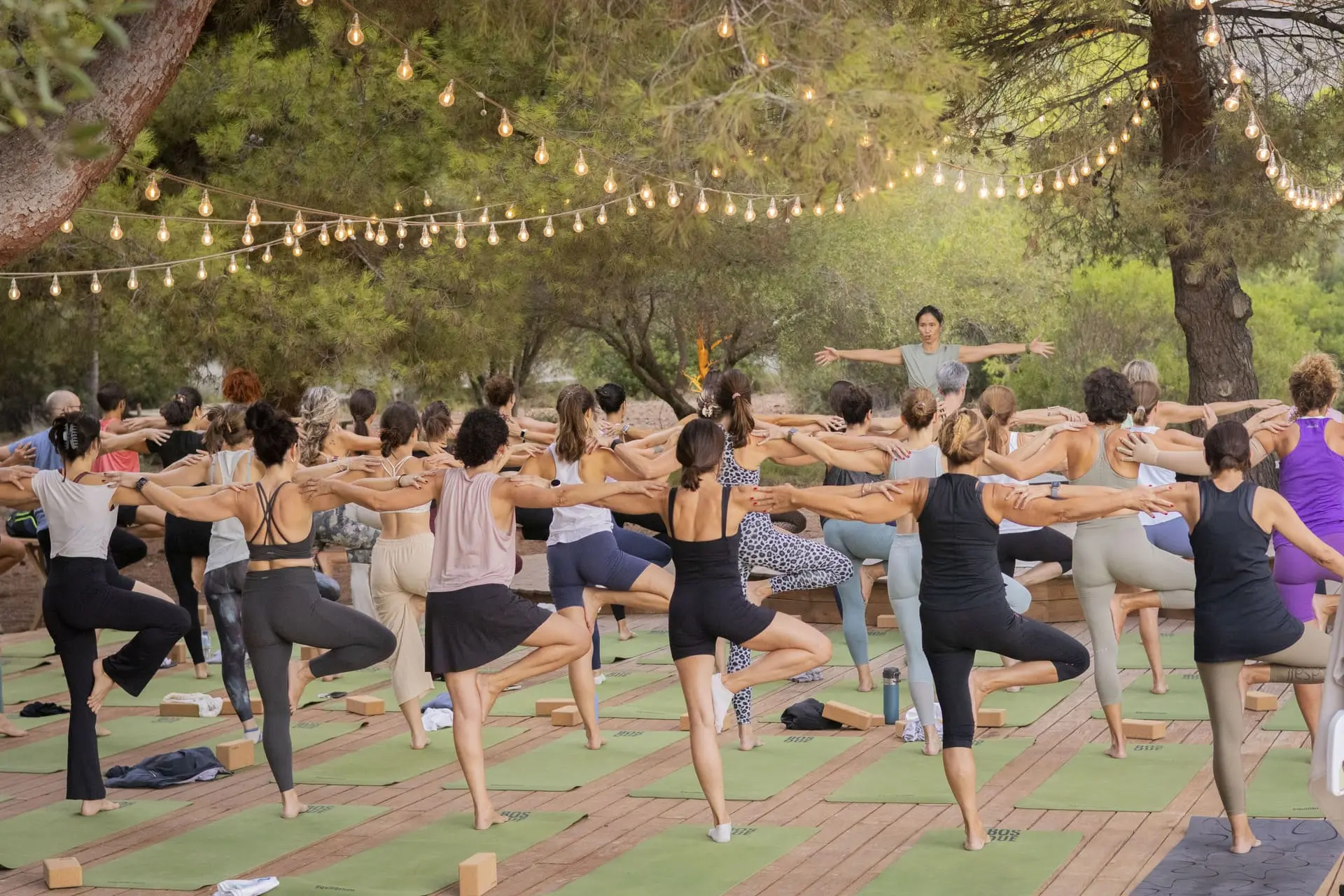
Gentle yoga, breathing exercises, guided meditation or stretching. They require no previous experience and adapt well to groups with very different levels. If space and time allow, doing them outdoors adds a great deal.
Physical and sports activities adapted to the team
Walks, functional circuits, padel by level or cooperative games. The intensity should be moderate and adjusted to each person’s abilities and preferences, with alternatives for those who don’t want to or can’t make a physical effort. The idea is for everyone to take part, not to stage a competition.
Nutrition and healthy habits workshops
A hands-on workshop, such as preparing a balanced lunch to take to the office, works better than a theoretical talk. Mediterranean cuisine is a good reference: it is familiar, based on seasonal produce and has been recognised by UNESCO as Intangible Cultural Heritage since 2013. Ideally, it should be led by a dietitian-nutritionist or a chef with training in the field.
Talks and workshops on preventive health
Preventive health at work fits well into a short talk format: ergonomics, rest and sleep, cardiovascular health or active breaks. When the topic requires it, they should be given by healthcare professionals or occupational risk prevention specialists. These actions complement occupational risk prevention but do not replace it: risk assessment and health surveillance remain obligations of the company under Spain’s Occupational Risk Prevention Act (Law 31/1995).
How to organise a corporate wellness day step by step
Organising a corporate wellness day comes down to five decisions: what it is for, who it is for, what will be done, where and how it will be evaluated afterwards.
Here we focus on what is specific to a wellness day. For the more logistical side, such as budget, suppliers or communication, see our guide on how to organise a corporate event.
- Define the objectives. Is the aim to ease tension after a period of heavy workload, bring together teams that work apart or kick off an employee wellness programme? The objective determines the activities, the duration and how results are measured.
- Understand the team’s needs, including accessibility. A short, anonymous survey before designing the programme avoids surprises: interests, schedules, allergies or diets, reduced mobility, injuries or pregnancies. With that information, alternatives can be prepared so that no one is left out.
- Select the activities and design the programme. A few well-run activities are better than a packed agenda. It is worth combining formats, leaving breaks between blocks and making participation in each activity voluntary.
- Choose the right venue. Check capacity, indoor rooms in case the weather turns, outdoor areas, accessibility, food offering and distance from the office. With large groups, the venue should allow several activities at once.
- Gather feedback and evaluate the results. A short form on the day or within the following 48 hours is enough. It helps improve the next edition and decide which actions continue throughout the year.
Example programme for a full day
| Time | Activity |
|---|---|
| 9:30 | Welcome with a healthy breakfast |
| 10:00 | Outdoor yoga and breathing, in groups by level |
| 11:15 | Preventive health talk: ergonomics and active breaks |
| 12:15 | Mediterranean cooking workshop in teams |
| 14:00 | Lunch |
| 15:30 | Walk or gentle sports activity |
| 16:30 | Closing and evaluation survey |
Bellver Blue Tech Zone: a setting for corporate wellness days
Bellver Blue Tech Zone brings together meeting spaces for companies and a setting designed for wellbeing in one place. It is located in Oropesa del Mar (Castellón), in an ecosystem of more than 700,000 m² by the Mediterranean.
For group sessions, talks and workshops, there are rooms for different group sizes, from the Zenit auditorium to the Almazara Room at the Masía, with capacity for 200 people. Outdoors, the Patio de los Olivos hosts up to 150 people among centuries-old olive trees.
Mindful movement has its place at Bosque Masía Bellver, a space dedicated to movement, breathing and reconnection where outdoor yoga sessions are held. The complex also has padel courts, its own Mediterranean-inspired food offering and the Hotel Masía Bellver for those who want to extend their stay. Each programme is designed according to the group’s objectives and size.
If you are considering organising a wellness day for your team, discover how Bellver can design a programme tailored to your company, combining activities, meeting spaces and food in a single setting.
Frequently asked questions about corporate wellness
What activities can be included in a corporate wellness day?
The most common are yoga and mindfulness, moderate-intensity sport, nutrition workshops and preventive health talks. Ideally, combine at least one movement block with a learning block, depending on the team’s interests.
How long should an employee wellness day last?
It can range from half a day to a full day, depending on the objectives, the group and the activities. For a first experience, a morning is usually enough; if there is lunch and several workshops, a full day is worthwhile.
If you are looking for a multi-day experience, in this article we explain the benefits of a corporate retreat for your company.
How can the results of a workplace wellness day be measured?
With four indicators: participation out of the total number of invitees, overall satisfaction, rating of each activity and interest in repeating. A five-question survey at the end of the day covers them all.
How can a wellness day be adapted to a large team?
By dividing the group into subgroups that rotate through the activities, with several instructors at the same time. It helps to let each person choose between options and to pick a venue with several areas, indoor and outdoor, to avoid waiting.
About the Author
Bellver Blue Tech Zone
The editorial team of Bellver Blue Tech Zone. We share stories about experiences, professional gatherings and celebrations in our Mediterranean setting.